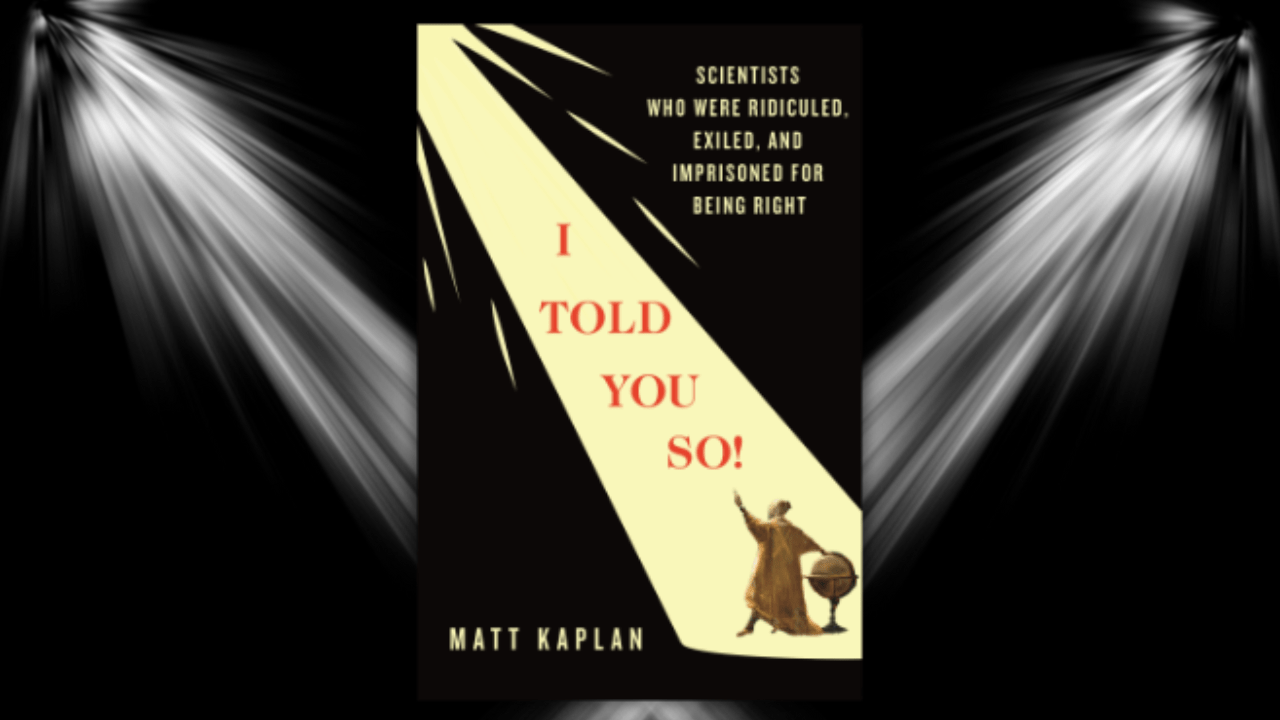
TL;DR: While fascinating, this read very slowly for me.
Source: NetGalley, thank you so much to the publisher!
Plot: An exploration through different times of scientists and doctors who were shunned or cast out.
Characters: Some of these will be familiar if you’re a history/medical history buff.
Setting: This was definitely western centric, primarily focused in on European and American individuals.
Readability: This is very approachable, but I was snoozing from time to time, I’m not going to lie.
Summary:
The Contrarians is a critical history of the scientific community, past and present, as Matt Kaplan shows how scientific breakthroughs often occur in spite of, rather than because of, the scientific community. Alternating between the past and the present, the book is anchored by the story of Hungarian physician Ignaz Semmelweis, who helped discover germ theory by realizing Puerperal fever—a devastating infection that most often strikes women who have recently given birth—was spread by doctors not washing their hands. Semmelweis was met with overwhelming hostility by those offended at the notion that doctors were at fault. Semmelweis as a prime example of the inefficiency of scientific progress—how hard the scientific community fights new ideas and new research, even when the facts are staring them in the face.
In snappy, accessible prose, Kaplan presents the cases of Galileo being threatened with torture, Charles Darwin facing social ostracism, and more recently, Katalin Karikó losing her job and her funding on the brink of discovering uses of mRNA – a discovery that would directly lead to the fast creation of a vaccine for Covid-19, and to a Nobel Prize for Karikó. With decades of first-hand reporting under his belt as the lead science reporter for the Economist, Kaplan makes the argument that science is hampered by the community’s resistance to younger scientists and new ideas—making it exceptionally difficult or outright impossible for critically important findings to gain recognition.
Employing persuasive examples spanning history, The Contrarians makes a compelling argument that the scientific community can work faster and better, if only it is open to change.
Thoughts:
I love that the first part of the pitch on this calls it ‘energetic’ when that is the complete opposite of my experience. For such a short book I found myself reading it for so long I thought it’d never stop!
This has, do not mistake me, some fascinating and interesting things in it. I had no idea the level of cut-throat, seeming meanness that can be in the scientific/research world. That bit was fascinating and news to me, and on the whole I found the paleontology sections deeply interesting. However the bulk of the text felt as if it focused in on medical history, especially that of germ history. This is something that’s very popular, and that I’ve read quite a bit on so I found tedious and familiar in a way that kept me uninterested.
This one I would recommend if you’re a beginner not only to the topic but to medical history as well. Any real familiarity may leave you in the same situation I was in, slightly sleepy and a bit bored.
 Sarah Evermotion's Reads
Leave a comment