TL;DR: A short and interesting peek into Jewish culture and memory books.
Source: NetGalley, thank you so much to the publisher!
Plot: We start discussing Jewish Memory books and look at culture within small towns before briefly touching WWII.
Setting: Primarily Poland area, though we bounce between small towns in other countries.
Readability: It’s definitely an easy read, a fascinating primer if you’ve never read about Jewish culture.
Summary:
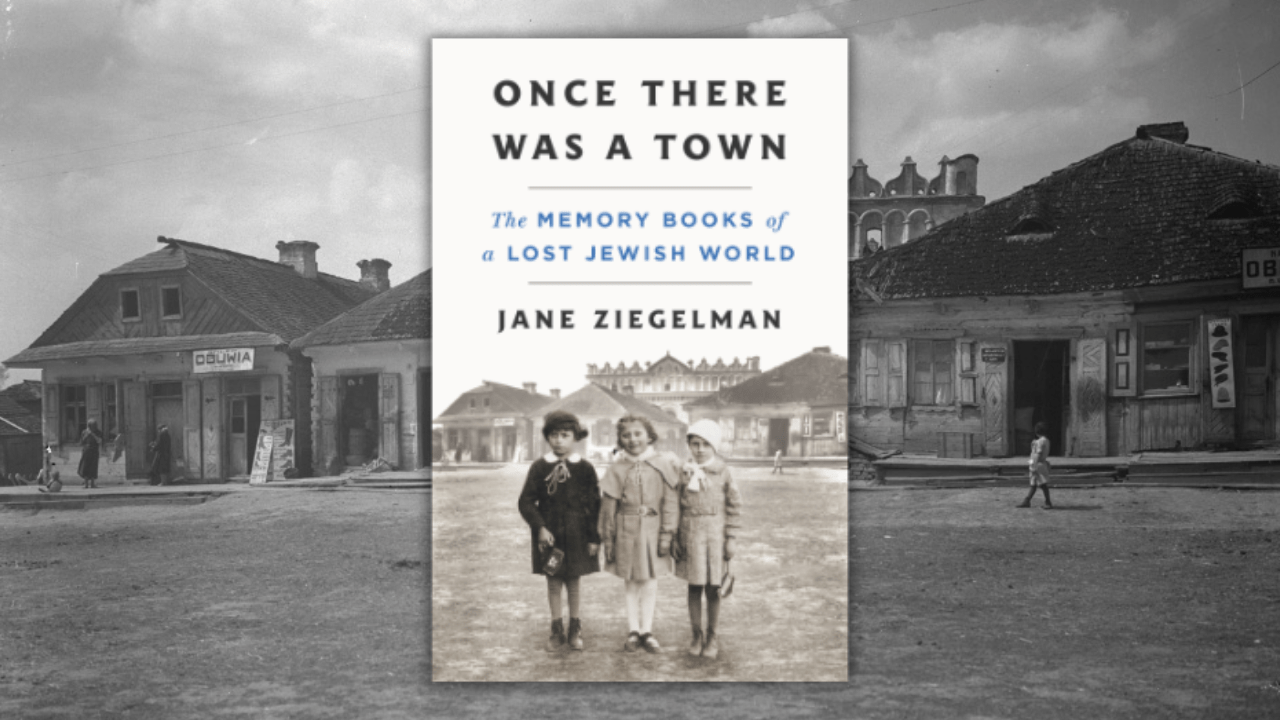
By the close of World War II, six million Jews had been erased from the face of the earth. Those who eluded death had lost their homes, families, and entire way of life. Their response was quintessentially Jewish. From a people with a long-history of self-narration, survivors gathered in groups and wrote books, yizkor books, remembering all that had been destroyed. Jane Ziegelman’s Once There Was a Town takes readers on a journey through this largely uncharted body of writing and the vanished world it depicts.
Once There Was a Town resounds with the voices of rich and poor, shopkeepers and tradespeople, scholars and peddlers, Zionists and Communists, men and women telling stories of the towns that were their homes. Stops are made in the bustling market squares where Jewish merchants catered to local farmers; study houses where men recited Torah; kitchens where homemakers baked 20-pound loaves of bread; cemeteries where mourners conversed with departed loved ones and wooded groves where young couples met for the occasional moonlit tryst. Of the many towns on Ziegelman’s itinerary, she always circles back to Luboml, her family’s ancestral shtetl and the point of departure for her own journey of discovery.
In conversation with classics by IB Singer and Roman Vishniac, Once There Was a Town is a landmark of rediscovery, and a love song to a vanished world.
Thoughts:
Once There Was A Town focuses on the memory books of lost Jewish towns. These books talk about and capture a culture that has largely been lost since the end of the World Wars. These little snapshots of the culture are fascinating but also heartbreaking. Our author’s own family was part of Luboml, a town that she explores through the memory book her family carries.
While the book focuses on this culture, the idea of these books and how they came about it doesn’t give nearly as much information on them as I expected. Perhaps due to the lack of books (I don’t know how many are in existence or how many the author had access too) I just didn’t love the length of this and what we got. I found so much interesting, I just really wished that there was more here. More towns, more memories and culture, etc.
If you are looking for more Jewish culture and history this is one I think that’s worth looking into, even with as short as it is. As far was World War history, it’s far lighter. But the culture and history is well worth looking for.
 Sarah Evermotion's Reads
Leave a comment